

 Chrome-Proxy-Erweiterung
 Firefox-Proxy-Erweiterung


Sprache / SDK
WeProxy-Proxy-Einrichtung Für Python
Der übliche Weg für Proxies in Python ist die requests-Bibliothek. Halten Sie Zugangsdaten aus dem Quellcode und laden Sie sie aus Umgebungsvariablen. HTTP-Tunnel- und SOCKS5-Beispiele folgen unten.
One of the most common ways to use a proxy in Python projects is the requests library. You can apply a proxy to a single request, a session, or all compatible requests through environment variables. This guide shows HTTP and SOCKS5 examples for a WeProxy connection.
Requirements
Install Python 3 and the Requests library:
python -m pip install requests
If you will use SOCKS5, install the extra dependencies:
python -m pip install "requests[socks]"
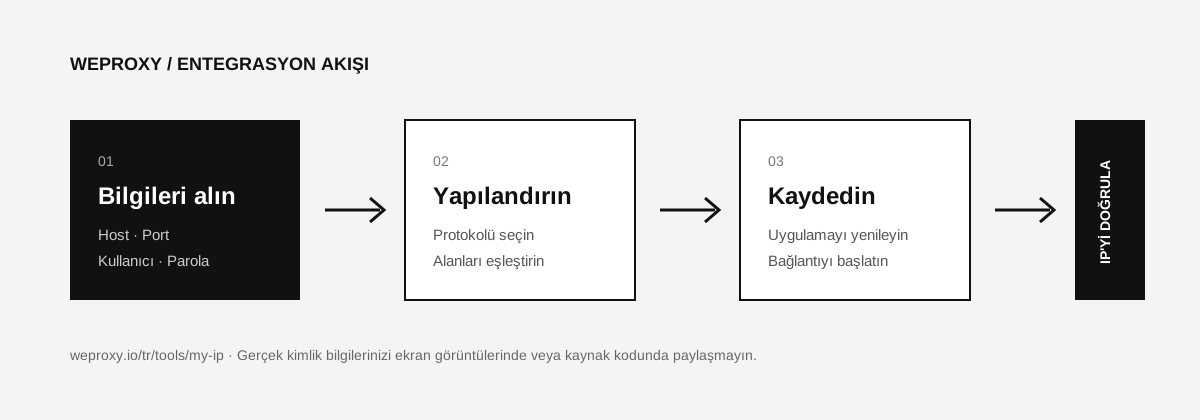
From the WeProxy panel, get the host, port, username, password, and the protocol your product supports.
Preparing Environment Variables
Keep credentials in the operating system’s environment variables instead of writing them into source code.
macOS/Linux:
export WEPROXY_HOST="PROXY_HOST"
export WEPROXY_PORT="PROXY_PORT"
export WEPROXY_USERNAME="PROXY_USERNAME"
export WEPROXY_PASSWORD="PROXY_PASSWORD"
PowerShell:
$env:WEPROXY_HOST="PROXY_HOST"
$env:WEPROXY_PORT="PROXY_PORT"
$env:WEPROXY_USERNAME="PROXY_USERNAME"
$env:WEPROXY_PASSWORD="PROXY_PASSWORD"
These variables are examples only. In production, use a secret manager and do not commit .env files to Git.
Using an HTTP Proxy with Requests
import os
from urllib.parse import quote

import requests

host = os.environ["WEPROXY_HOST"]
port = os.environ["WEPROXY_PORT"]
username = quote(os.environ["WEPROXY_USERNAME"], safe="")
password = quote(os.environ["WEPROXY_PASSWORD"], safe="")

proxy_url = f"http://{username}:{password}@{host}:{port}"
proxies = {
    "http": proxy_url,
    "https": proxy_url,
}

response = requests.get(
    "https://api.ipify.org?format=json",
    proxies=proxies,
    timeout=30,
)
response.raise_for_status()
print(response.json())
A proxy URL that starts with http:// does not mean you cannot reach HTTPS destinations. Requests can tunnel HTTPS targets through an HTTP proxy. If your panel specifies a different scheme, follow the product details.
Using a Proxy with a Requests Session
To reuse the same setting across multiple requests, you can create a Session:
with requests.Session() as session:
    session.proxies.update(proxies)
    response = session.get("https://api.ipify.org?format=json", timeout=30)
    response.raise_for_status()
    print(response.json())
According to the Requests docs, proxy values in the system environment can override session.proxies. When you need a definite proxy choice, passing proxies=proxies directly on each request is more predictable.
Using a SOCKS5 Proxy
proxy_url = f"socks5h://{username}:{password}@{host}:{port}"
proxies = {
    "http": proxy_url,
    "https": proxy_url,
}

response = requests.get(
    "https://api.ipify.org?format=json",
    proxies=proxies,
    timeout=30,
)
print(response.json())
With socks5h://, domain name resolution happens on the proxy side. With socks5://, DNS resolution happens on the client side.
Python Proxy Errors
407 Proxy Authentication Required
The username or password is wrong. Check that special characters were URL-encoded and that the product supports username/password authentication.
ProxyError or connection timeout
Verify the host, port, protocol, and package status. If the destination does not support IPv6, a connection with an IPv6 proxy may fail.
The real IP is visible
Confirm that the proxies dictionary was passed to the request. A NO_PROXY environment variable may be excluding the destination domain.
Source
- Requests documentation: Proxies
- Runnable example: weproxy-io/python-proxy
Weitere Integrationen
Ein anderes Tool im Blick?

Jetzt Starten
Jetzt mit WeProxy verbinden
Konto erstellen, 100 MB kostenlosen Residential-Traffic sofort nutzen und die Schritte oben in Ihrer eigenen Einrichtung umsetzen.